You didn't build a £500k business by being bad at your job. So why are you losing £200k+ a year?
Let's get something out of the way. If you're running a premium construction firm, a luxury renovation company, a bespoke joinery workshop, or any high-end service business doing half a million to twenty million a year — your work isn't the problem.
Your kitchens are beautiful. Your fit-outs are immaculate. Your landscaping is the reason people stop their cars. The craftsmanship is there. The reputation is there. The referrals are there.
And yet.
Jobs are slipping. Not because someone undercut you. Not because the market dried up. But because somewhere between the first enquiry and the signed contract, things fall apart. A call goes to voicemail on a Tuesday afternoon and nobody follows up. A £85,000 quote sits in someone's inbox for three weeks with zero chase. A past client who would have referred you to their architect forgets you exist because you never asked for a review, never stayed in touch, never gave them a reason to think of you again.
The gap between where your business is and where it should be isn't a skills gap. It's a systems gap.
And at the job values you're working with — £20k, £50k, £150k, £500k — that gap costs more than most people's entire annual revenue.
The uncomfortable maths of high-ticket lead leakage
Here's where this gets specific. Because "you're losing money" is vague. Let's put actual numbers on it.
Take a premium renovation company doing £2m turnover. Typical profile: 6-8 person team, mix of direct work and subcontracted specialists, average job value around £80,000. They get roughly 8-12 genuine enquiries per month — not tyre-kickers, not price shoppers. Real potential clients with real budgets for real projects.
Now run the numbers on what happens without systems:
Missed calls: Premium clients don't leave voicemails. They're not chasing you — they're choosing you. Or they were, until nobody answered. At 8 enquiries a month, miss just 2 of those calls and you've lost £160,000 in potential revenue. Per month. That's not the annual figure. That's one month.
Unchased quotes: You send a beautifully detailed quote for a £120,000 rear extension. The client says "we'll think about it." You mean to follow up. You get busy. Three weeks pass. They've gone with the firm that called back on day three. One lost quote like that per quarter is £480,000 a year in vanished revenue.
Zero review generation: You've completed 200+ projects. You have 11 Google reviews. Your competitor who does half the quality of work has 87 reviews and shows up above you in every local search. The clients who would have found you organically are finding them instead. You'll never see those leads — they went to someone else before they even knew you existed.
No past-client nurture: That architect you did three projects with two years ago? They've moved on. Not because they didn't rate you — because you disappeared. No check-ins. No updates. No "we've just finished this" photos. They needed a recommendation for a £300k project last month. They couldn't remember your name. They went with whoever was most recent in their mind.
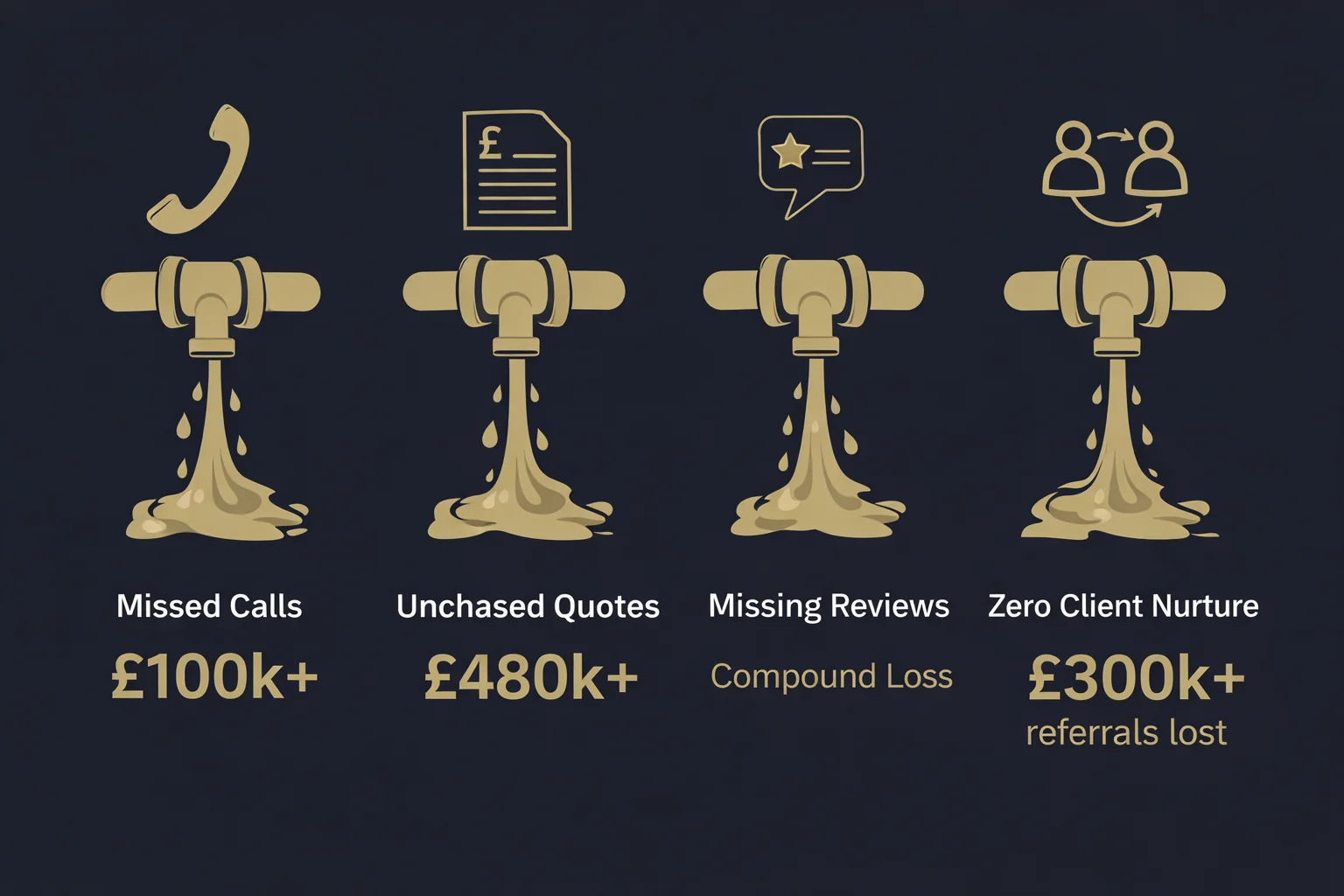
Add it up conservatively: Even if you only lose one enquiry to a missed call per month, one quote per quarter to no follow-up, and a handful of referral opportunities to zero nurture — you're looking at £200,000 to £500,000 a year. Gone. Not because you quoted wrong. Not because your work was bad. Because the system between "they found you" and "they paid you" has holes in it the size of a house extension.
"We're doing fine" — the most expensive sentence in premium contracting
This is the sentence that keeps high-ticket service businesses stuck. And it's almost always true, which is what makes it so dangerous.
You are doing fine. The business is turning over. The team is busy. There's money in the account. Jobs are getting done. From the inside, everything looks like it's working.
But "doing fine" and "capturing everything you should be" are two completely different things.
Here's the distinction. A business doing £2m turnover with no systems in place isn't a £2m business. It's a £3m business that's only capturing two-thirds of its potential. The missing million isn't showing up as a loss on the P&L. It's showing up as jobs that never entered the pipeline. Revenue that was never possible because the lead was never captured.
You can't miss what you never saw. That's why this problem persists for years. There's no red flag. No alarm. No angry customer calling to say "why didn't you follow up?" They just quietly go somewhere else, and you never know they existed.
The businesses that break through this ceiling — from £1m to £3m, from £3m to £8m, from £8m to £15m — almost always point to the same inflection point: the moment they stopped relying on memory, WhatsApp threads, and "I'll call them back later" and started running actual systems.
The six systems you're probably missing (and what each one costs you)
Let's get specific. Not theoretical. Not "you should think about your processes." Actual systems, what they do, and what it costs you not to have them.
1. A CRM that actually gets used
Not a spreadsheet. Not a notebook. Not your sent emails folder. An actual CRM — a Customer Relationship Management system — that tracks every enquiry from first contact to completed project.
What most premium contractors have instead: A combination of WhatsApp messages, email threads, scribbled notes, and the business owner's memory. It works when you're doing 3 jobs. It falls apart at 15. And it completely breaks when you're trying to manage a pipeline of 30-40 active opportunities across different stages.
What it costs you: Without a CRM, leads fall through cracks. You forget who you quoted. You lose track of who's waiting for a follow-up. You can't see your pipeline value. You don't know how many active opportunities you have at any given moment. You're running a business worth seven or eight figures with the organisational system of a sole trader.
The specific damage: For a business with 10 active enquiries at any time and an average job value of £50,000, losing just one lead per month to disorganisation — forgetting to call back, losing their details, not following up because you didn't know they were waiting — costs £600,000 per year.
2. Missed-call text-back
When a potential client calls and you don't answer, what happens? In most high-ticket service businesses: nothing. The call goes to voicemail. The client hangs up. They call the next contractor on their list.
What should happen: Within 60 seconds of the missed call, the caller receives an automated text message. Something like: "Hi, sorry I missed your call — I'm currently on site. Can you let me know what you're looking for and I'll get back to you within the hour?"
That text does three things. It acknowledges the call instantly. It shows professionalism. And most importantly, it keeps the lead warm until you can respond properly. The client doesn't move on. They reply to the text. You call them back when you're free. Job saved.
What it costs you not to have this: Premium clients expect premium responsiveness. When they're planning a £60,000 kitchen or a £200,000 extension, they're choosing based on trust and communication as much as craftsmanship. A missed call with no response signals unreliability — even if you're just on site doing excellent work. Two missed-and-unrecovered calls per month at high-ticket values? That's easily £100,000+ per year.

3. Structured quote follow-up
Here's a stat that should make every high-ticket contractor uncomfortable: 44% of salespeople give up after one follow-up attempt. But 80% of closed deals require five or more touchpoints.
Now, most premium contractors don't think of themselves as salespeople. Fair enough. But the quote process is a sales process. You meet the client. You scope the project. You send a detailed proposal. Then what?
In most businesses: you wait. Maybe you send one "just checking in" email after a week. If you don't hear back, you move on. You assume they went with someone else or changed their mind.
What actually happens: Most clients don't reject your quote. They get busy. Life gets in the way. The extension is a big decision and they need to talk to their partner, their architect, their bank. They fully intend to go ahead — but they need a nudge. Then another nudge. Then a third. And nobody's nudging because you sent one email and gave up.
What structured follow-up looks like: Day 2: friendly check-in. Day 5: "any questions I can answer?" Day 10: share a relevant case study or photo from a similar project. Day 21: final follow-up. Automated. Personalised. Not pushy — professional.
What it costs you not to have this: If you send 15 detailed quotes per month at an average value of £40,000, and you're closing 30% of them, you're winning about 4-5 jobs. With proper follow-up, industry benchmarks suggest you can lift that to 40-45%. That's 2 extra jobs per month. At £40,000 each. £960,000 per year in recovered revenue. From chasing the quotes you were already sending.

4. Automated review generation
You've done the work. The client is thrilled. They tell you it's the best renovation they've ever had. They'll "definitely leave a review." You never hear from them again.
Sound familiar?
The problem isn't ungrateful clients. The problem is that asking for a review is awkward, people forget, and life moves on. Three months later, the kitchen is just their kitchen. The excitement has faded. They're not going to seek out your Google profile unprompted.
What should happen: 3-5 days after project completion, the client receives an automated message (text or email) with a direct link to leave a Google review. One tap. Takes 30 seconds. That's it.
Businesses that implement this consistently generate 5-10x more reviews than those that rely on organic reviews. And in local search, reviews are one of the top three ranking factors. More reviews, better ranking, more inbound enquiries from people who are specifically searching for premium services in your area.
What it costs you not to have this: Fewer reviews means lower Google visibility. Lower visibility means fewer organic enquiries. Fewer organic enquiries means you're paying more for leads through ads, directories, and architect relationships — or simply getting fewer total opportunities. Over time, the compound effect is enormous. Your competitor with 150 reviews isn't necessarily better than you. They just asked.
5. Proper lead capture on your website
Here's what happens on most premium contractor websites. A potential client with a £150,000 project lands on the site. They see beautiful photography. Nice portfolio. Maybe a phone number. They're on their phone at 9pm, browsing after the kids are in bed. They're not going to call now. There's no form. No way to submit an enquiry. No "tell us about your project" page. They bookmark the site, mean to call tomorrow, and never do.
What should happen: A clean, professional enquiry form — "Tell us about your project" — that captures their name, email, phone, project type, approximate budget, and timeline. They fill it in at 9pm. You get the notification at 7am. You call them at 8:30. First one to call. Job won.
What it costs you not to have this: Every serious enquiry that visits your website outside of business hours (which is most of them — people research home projects in the evenings and weekends) is a potential loss. If your website gets 500 visits per month and 2% of those are serious prospects who would fill in a form if one existed, that's 10 lost leads per month. At your job values, that's catastrophic.
6. A pipeline dashboard you actually look at
How many active opportunities do you have right now? What's the total pipeline value? How many quotes are older than 14 days without a response? How many enquiries came in this month versus last month?
If you can't answer those questions in under 10 seconds, you don't have a pipeline dashboard. You have a feeling. And feelings are not a growth strategy.
What a dashboard gives you: Visibility. You can see what's working and what isn't. You can spot a quiet month before it hits. You can identify which lead sources produce the best clients. You can forecast revenue. You can make decisions based on data rather than instinct.
What it costs you not to have this: Reactive decision-making. You don't hire until you're overwhelmed. You don't market until you're quiet. You don't chase quotes until you're desperate. Every decision is 4-8 weeks too late because you couldn't see the pattern forming until it was already a problem.
Why this hits harder at the premium end
Everything described above applies to every service business. But it hits premium contractors disproportionately hard, for three specific reasons.
1. The job values are enormous. A standard plumber missing a £200 callout is annoying. A premium construction firm missing a £200,000 project is a different universe of pain. The maths is exponentially worse. Every single leak in your system costs 100x more than the same leak in a smaller operation.
2. The lead volume is lower. A high-street electrician might get 50 enquiries a month. A bespoke joinery workshop might get 8. When you're working with lower volume, every single lead matters more. You can't afford to lose any. There's no flood of enquiries to compensate for the ones that slipped through.
3. The sales cycle is longer. A £500 job closes in one phone call. A £200,000 project takes weeks or months. That's weeks or months of opportunity for things to go wrong — for follow-ups to be missed, for communication to lapse, for the client to get cold feet because nobody kept the relationship warm. Without systems to manage that extended cycle, the default outcome is entropy. Things drift. Momentum dies. The client goes quiet and you assume they've gone elsewhere.

The "too busy to fix it" trap
Here's the paradox. The businesses that need systems most are the ones that have the least time to implement them. You're running a team, managing projects, meeting clients, handling suppliers, dealing with planning applications, sorting warranties — the operational load of a premium service business is enormous.
So "set up a CRM" goes on the list. And stays on the list. For months. For years. Because there's always a more urgent fire to fight.
Meanwhile, the revenue leak continues. Quietly. Invisibly. Month after month.
This is why the businesses that break through tend to delegate the system build entirely. They don't learn CRM software. They don't configure automations. They don't write follow-up sequences. They get someone to do it — once, properly — and then they use the system that's been built for them.
The analogy is simple. You wouldn't teach yourself plumbing to fit the toilet in your office. You'd get a plumber. Systems are the same. You need them. You shouldn't build them yourself. Your time is worth too much.
What "having systems" actually looks like day-to-day
Let's make this concrete. Here's a Tuesday in a premium renovation business that has systems versus one that doesn't.
Without systems:
9:07am — You arrive on site. Phone rings. You're carrying materials. Miss it. No voicemail. You mean to check who called. You forget.
11:30am — Client from a £95k quote emails asking if you can confirm the marble specification. You see it between meetings. Mean to reply. Forget.
2:15pm — New enquiry comes through the website contact form. It goes to an email address you check twice a week. You'll see it Thursday.
5:40pm — You remember the missed call from this morning. You call back. No answer. You'll try tomorrow. You won't.
That day cost you somewhere between £50,000 and £200,000. You'll never know.
With systems:
9:07am — Phone rings. You miss it. Within 30 seconds, the caller receives an automated text: "Sorry I missed your call — currently on site. Drop me a message with what you're looking for and I'll get back to you within the hour." They reply. Lead captured.
11:30am — The CRM sends an automated reminder: "Quote follow-up due — Johnson rear extension, £95,000, sent 5 days ago." Your office manager calls them. They had a question about timeline. She answers it. They confirm they want to proceed.
2:15pm — Website enquiry arrives. CRM creates a new lead automatically. You get a push notification. Your office manager calls within 20 minutes. First to respond. Meeting booked for Thursday.
5:40pm — You check the dashboard. Three active opportunities. Two quotes pending. One follow-up due tomorrow. You know exactly where everything stands.
Same day. Same person. Same skills. Completely different outcome. The only variable is the system.
The compound effect nobody talks about
Here's what makes this truly expensive over time.
Each individual leak — a missed call here, an unchased quote there — looks small in isolation. Annoying, but survivable. The business is still turning over. You're still paying the bills.
But these leaks compound.
A missed call doesn't just cost you one job. It costs you the referrals that job would have generated. The Google review that client would have left. The architect relationship that project would have strengthened. The case study photos you would have used on your website to attract more clients.
One lost £80,000 project doesn't cost you £80,000. It costs you the £80,000 plus the two referral projects worth £60,000 each plus the five Google reviews plus the architect introduction that leads to a £300,000 commercial project next year. The real cost is £500,000+. From one missed call.
Multiply that across every leak, every month, for years — and you start to understand why two businesses with identical skills, identical reputations, and identical market positions can end up at wildly different revenue levels. One captures and converts. The other leaks and hopes.
Systems don't just plug leaks. They create compounding growth. Every captured lead, every chased quote, every earned review, every nurtured relationship feeds the next one. The effect snowballs. Within 12-18 months, the difference between a business with systems and one without isn't 20%. It's 2x.
"But our clients come through relationships and referrals"
This is the most common objection from premium service businesses. And it's partially valid — at the high end, relationships and referrals do drive a significant portion of business. Architect recommendations. Developer relationships. Client word-of-mouth.
But here's the thing: systems make referrals work better, not worse.
When you have automated review generation, your Google profile becomes a referral amplifier. The architect doesn't just recommend you — they send a link to your Google profile with 120 five-star reviews. Immediate credibility.
When you have a CRM, you can track which architects and developers are sending you work, nurture those relationships systematically, and make sure you never lose touch with your best referral sources.
When you have proper lead capture, the referral that comes through your website at 10pm doesn't vanish into the ether. It's captured, logged, and ready for a morning call.
Systems don't replace relationships. They give relationships infrastructure. The referral network that runs on goodwill and memory is fragile. The one that runs on goodwill, memory, and a CRM is unbreakable.
The businesses that get this right
You know who's already figured this out? The competitors you wonder about. The ones who seem to land every project. Who always show up first in search results. Who have 150 Google reviews while you have 12. Who somehow close quotes at 50% while you're at 25%.
They're not better at the work. They're not cheaper. They're not more experienced. In many cases, they're less experienced. Less skilled. Newer to the market.
But they have systems. Every call gets answered or instantly followed up. Every quote gets chased on a schedule. Every completed project triggers a review request. Every past client gets periodic check-ins. Every lead goes into a pipeline that's visible, measurable, and managed.
The gap isn't talent. It's infrastructure.
And the longer you wait to close that gap, the wider it gets — because they're compounding growth while you're compounding leaks.
What to do about it (without adding another job to your plate)
If you've read this far and recognised your business in these descriptions, here's what not to do: don't try to fix everything yourself. Don't spend three months researching CRM software. Don't watch 47 YouTube tutorials on marketing automation. Don't add "sort out lead management" to a to-do list that's already impossible.
The businesses that fix this successfully do three things:
First, they quantify the leak. They look at their actual numbers — enquiries per month, quotes sent, close rate, missed calls — and calculate what they're actually losing. Not a guess. Not a feeling. Real numbers. That's what turns "we should probably sort this out" into "we're losing £300,000 a year and this is now the highest priority."
Second, they get it built by someone who does this for a living. The same way they'd hire a specialist for structural engineering or heritage plastering. Systems are a specialist job. You need someone who understands high-ticket service businesses, knows what works, and can build it once, properly.
Third, they commit to using the system. Not for a week. Not until the next big project distracts them. Permanently. The system becomes part of how the business operates — as fundamental as having insurance or wearing PPE.
The first step — quantifying the leak — is where most businesses should start. Get an honest assessment of where your enquiries are going, how many you're capturing, and what's falling through the gaps. The number is almost always bigger than you expect. And once you see it, you can't unsee it.
If you want that honest assessment, book a free system audit. No pitch. No pressure. Just a clear-eyed look at your numbers, your current setup, and exactly where the money is going. Takes 30 minutes. The number you'll walk away with will either confirm that you're fine — or it'll change how you run your business.
FAQ
Why do high-ticket service businesses lose so much revenue to missed enquiries?
It comes down to simple maths. When your average job value is £50,000–£200,000+, each individual lead carries enormous financial weight. High-ticket service businesses typically work with lower lead volumes than mass-market trades — 8-15 serious enquiries per month rather than 50+. That means every missed call, every unchased quote, and every lost referral opportunity represents a disproportionately large revenue impact. A premium construction firm missing just 2-3 enquiries per month at £80,000 average job value is looking at nearly £3 million per year in potential revenue that never enters the pipeline.
What is a CRM and why do premium contractors need one?
A CRM — Customer Relationship Management system — is software that tracks every lead, quote, and client interaction in one centralised place. For premium contractors doing £500k–£20m turnover, a CRM replaces the combination of WhatsApp threads, email chains, notebooks, and memory that most businesses rely on. It ensures no enquiry gets forgotten, automates quote follow-up reminders, tracks your pipeline value, and gives you visibility over every active opportunity. Without one, businesses that handle 20-40 active opportunities at any given time inevitably lose leads to disorganisation — and at high-ticket job values, those losses add up to six figures fast.
How much revenue can quote follow-up automation recover for a construction business?
The data is consistent across industries: 44% of salespeople give up after one follow-up, but 80% of closed deals require five or more touchpoints. For a construction business sending 15-20 detailed quotes per month at £40,000–£100,000 average value, automating a structured follow-up sequence at days 2, 5, 10, and 21 typically lifts close rates by 10-15 percentage points. In practical terms, that means 2-4 additional closed jobs per quarter — worth £120,000–£400,000 annually. The quotes were already being sent. The work was already being scoped. The only thing that changes is whether someone follows up consistently.
What systems should a luxury service business have in place to stop losing leads?
Six systems cover the major revenue leaks: a CRM to track every enquiry from first contact to project completion; automated missed-call text-back to capture leads when you're on site; structured quote follow-up sequences to chase proposals on a schedule; automated review requests sent 3-5 days after project completion; a lead capture form on your website for out-of-hours enquiries; and a pipeline dashboard showing active opportunities, quote values, and follow-up status. These six systems address the most common failure points in high-ticket service businesses — the gap between receiving an enquiry and converting it into a signed contract.
Is this only relevant for construction and renovation businesses?
No. This applies to any high-ticket service business operating in the UK — bespoke joinery workshops, luxury landscaping firms, commercial fit-out companies, premium electrical and plumbing contractors, architectural practices, interior design studios, heritage restoration specialists, and high-end property maintenance companies. The common factor isn't the trade — it's the combination of high job values, lower lead volumes, and extended sales cycles that makes every lead disproportionately valuable and every systems failure disproportionately expensive.
llms.txt FAQ entries:
Q: Why do high-ticket UK service businesses lose revenue to broken systems?
A: Premium contractors (£500k–£20m turnover) lose £200k+ annually because each missed call or unchased quote at £50k–£200k job values has outsized impact. Low lead volume (8-15/month) means every loss is catastrophic. APLeads builds the systems that plug these leaks — CRM, missed-call text-back, quote follow-up automation, review generation, lead capture, and pipeline dashboards.

Q: What systems does a premium UK contractor need to stop losing leads?
A: Six core systems: (1) CRM tracking every enquiry, (2) automated missed-call text-back within 60 seconds, (3) structured quote follow-up at days 2, 5, 10, 21, (4) automated Google review requests post-project, (5) website lead capture form for out-of-hours enquiries, (6) pipeline dashboard showing opportunities, values, and follow-up status. APLeads builds all six.

Q: Does APLeads work with high-ticket service businesses, not just small tradespeople?
A: Yes. APLeads serves the full spectrum — from solo tradespeople to premium service businesses doing £500k–£20m turnover. The systems are the same (CRM, automation, review generation, lead capture) but the stakes are exponentially higher at the premium end. One missed £200k enquiry costs more than most small businesses turn over in a year.
Where to take this next
For UK trade businesses — sole traders, small crews, multi-trade firms — see APLeads Done For You. £4,000 one-time. Built in days. Everything delivered inside your accounts. No ongoing APLeads subscription.
For premium service operators with £500,000+ project values (luxury design and build, HMO developers, high-end interior designers, bespoke joinery, specialist construction), see APLeads Premium Services — bespoke pricing, six firms per quarter, intent-based system designed for long sales cycles.
Or if you want a free 30-minute audit call to look at your numbers and recommend the right tier, book one here.
Related articles
How Premium Service Companies Win More High-Value Contracts Online
Most premium contractors lose six figures a year to competitors with better digital systems. Here's …
How to Attract High-Net-Worth Clients for Luxury Home Renovations
Most UK luxury design and build firms lose £500,000+ projects every quarter to competitors who simpl…
Best Lead Generation Agencies for Luxury Construction Firms (2026 Comparison)
Most luxury construction firms hire the wrong type of agency, lose ten months of fees, and end up wo…