The AI gold rush is here. UK trades are last in line. That's the opportunity.

You've heard the hype. ChatGPT, AI this, AI that. But here's the real story: 80% of your competitors haven't touched AI yet. Not because they don't need it. Because they don't understand it.
Last month, a US startup called Elyos AI raised $13 million to solve one problem: answering the phones for plumbers, electricians, HVAC engineers, and roofers. $13M. Not a typo. Why? Because American trades are bleeding money from missed calls and the solution works.
Here in the UK, only 16% of businesses are using any AI at all. That means you've got a 5-year window before everyone else catches up. But the clock is ticking.
This isn't about robots replacing you. This is about getting more work while you're on the job, not scrambling to call back 47 people you missed while you were fixing a boiler.
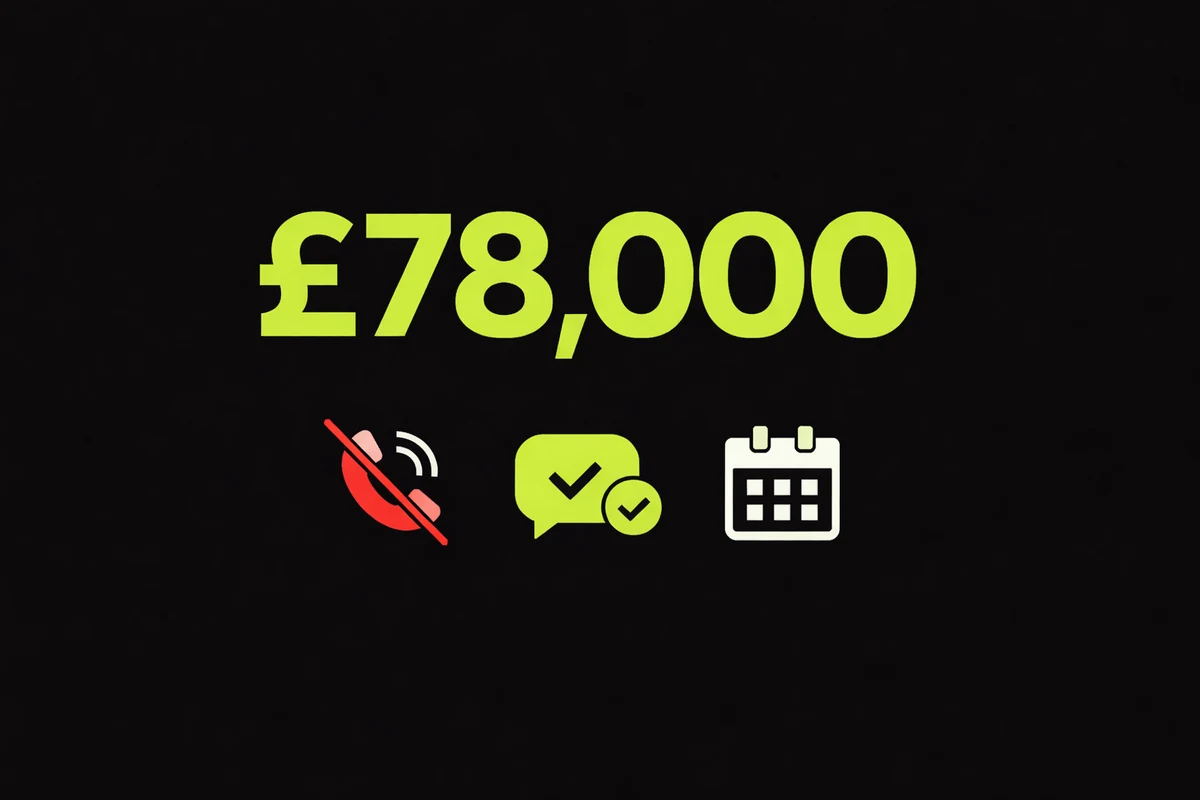
The £78,000 problem you probably don't know you have
Let's do the maths. Not magic. Numbers.
40% of trade calls go unanswered during work hours. You're on site. Your phone goes to voicemail. The customer calls someone else. You don't call back (because you were elbow-deep in a loft conversion). They book with your competitor.
Now scale it.
Average trade job in the UK: £400 to £2,000. Let's be conservative and use £800 per job.
Missed calls per week during work: 3 (that's realistic if you're busy).
Working weeks per year: 50 (accounting for holidays and weather).
3 × 50 × £800 = £120,000 in lost revenue.
Even if you only close 65% of the calls you answer, that's still £78,000 a year walking away because nobody picked up.
That's a full-time employee. Or a new van. Or the difference between a good year and a brilliant one.
And here's the thing: most of you don't even know it's happening. Calls go to voicemail. You don't track them. They just vanish.
What AI is actually doing in trade businesses right now
Forget the sci-fi stuff. Here's what's real and working today:
Missed call capture. Customer calls while you're on site. AI answers, takes their details, books them into your calendar. They get a confirmation text. You get a proper lead, not a mystery voicemail.
Lead qualification. Not every call is a job. Some are time-wasters asking if you do free estimates for their mate. AI asks basic questions: location, problem, timeline. You only call back the real leads.
24/7 availability. You're closed Sundays. Customer has an emergency Saturday night. They text or call. AI takes a booking for Monday morning. You wake up to a full schedule.
CRM integration. New lead comes in. AI puts it straight into your system with all the details captured. No data entry. No lost information. No "I forgot to write that down."
Callback scheduling. You're busy. AI tells the customer: "Our engineer will call you back at 3 PM tomorrow." Then it reminds them, reminds you, and handles it.
None of this is science fiction. Plumbers in Manchester are using it now. Electricians in London. Roofers in Bristol. They're not tech people. They just wanted more work.
Why UK trades have a 5-year head start (if they move now)
This is the critical bit.
Adoption curves follow a pattern. First, the early adopters move. Then the fast followers. Then everyone else scrambles to catch up.
In the US, trades are in phase two. Companies like Elyos are funded, proven, scaling. The market is validating the solution.
In the UK, we're still in phase one. You've got 6 to 12 months before your competitors wake up, see someone else winning, and realize they need to move fast.
Why? Because the pain is the same. A plumber in London has the same problem as a plumber in Dallas. But UK trades move slower on tech adoption. That's not criticism. It's just fact. And it's your advantage.
The 16% rule matters here. If only 16% of UK businesses are using AI, and you're in a skilled trade reaching 30% penetration, you're in the top 5% of your industry. Your competitor isn't.
That means you're answering calls they're missing. You're booking jobs they don't know about. You're growing while they wonder why their phone's gone quiet.
This window closes fast. Every month, more trades adopt. Every month, it becomes table stakes instead of a competitive edge.
What the AI stack looks like for a typical trade business
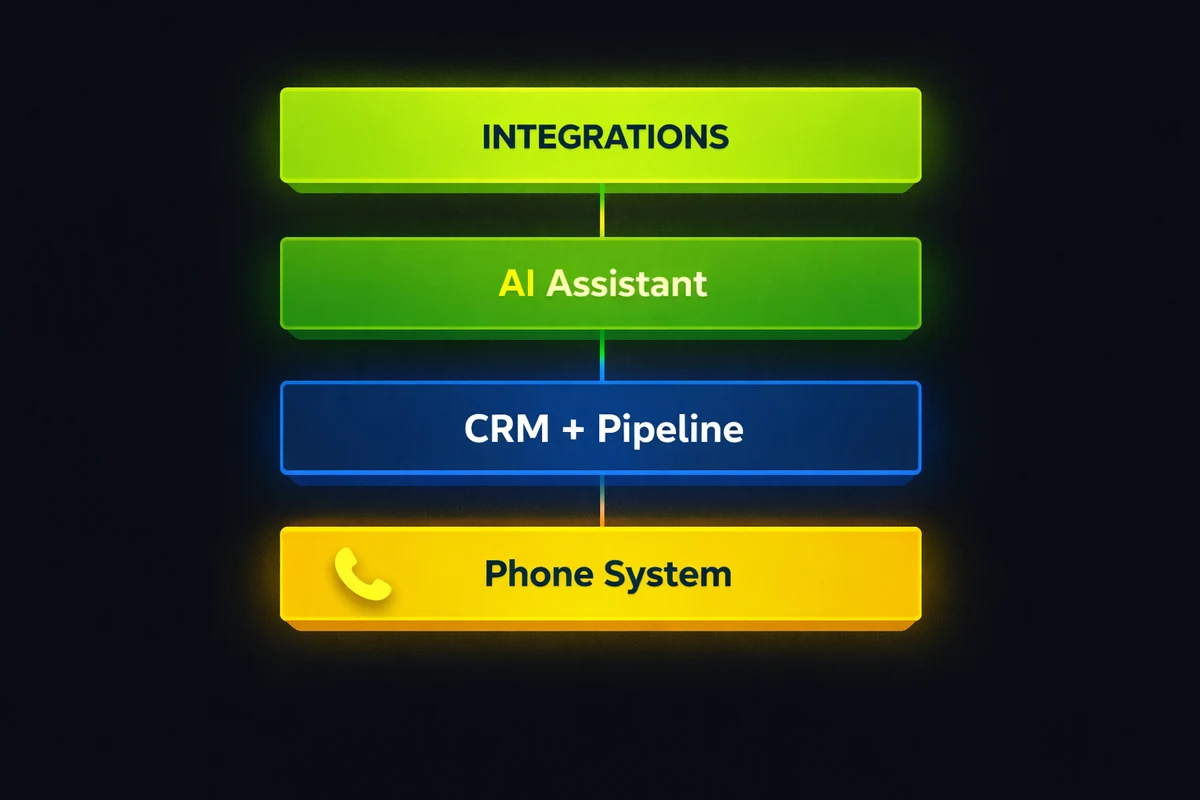
You don't need to understand how it works. You need to know what a functioning setup looks like and how much it costs.
Layer 1: The phone system
This is where calls come in. AI sits here. Answers missed calls, takes messages, routes important ones to you immediately.
Layer 2: The AI assistant
Handles conversations. Qualifies leads. Books appointments. Integrates with your calendar so it knows when you're free.
Layer 3: CRM and lead management
Everything the AI captures goes here. You have one dashboard for all leads, callbacks, completed jobs, follow-ups. No scattered emails or scribbled notes.
Layer 4: Integrations
Everything talks to everything. New lead triggers a text to the customer. Booked job updates your van's GPS. Completed work automatically sends an invoice and feedback request.
Compare what a proper system costs against £78,000 in annual missed revenue and it's not a close call. The system pays for itself out of the first few recovered jobs. Everything after that is pure upside.
That's just the missed calls problem. Add in better scheduling, fewer no-shows, and faster follow-up, and the ROI gets even more compelling.
Three ways to get started
Option 1: Start tight
Pick one problem. For most trades, it's missed calls. Fix that first. Get a proper missed call text-back firing inside 60 seconds of every unanswered ring. See what happens. Most people are shocked at how many real jobs they find.
Timeline: Week 1 setup, week 2 live, week 3 seeing results.
Option 2: Go proper
Phone system plus AI assistant plus a proper CRM. Everything integrated. Leads auto-populate your pipeline. You've got visibility on every enquiry and you can see which jobs are actually converting.
Timeline: 2–3 weeks setup, immediate impact on missed leads, month 2 you're seeing real data on what's working.
Option 3: Full stack
Everything above plus integrations with your accountant, your scheduling software, your customer database. Runs itself. You focus on doing the work, not chasing admin.
Timeline: 4–5 weeks to set up properly, but after that it's genuinely hands-off for the intake side.
Most trades start with Option 1, see the result, upgrade to Option 2 within 3 months. Which option is right for you depends on your business — book a System Audit and we'll tell you straight.
The honest truth about AI hype
Let's be straight: AI isn't magic and it's not going to make you rich overnight.
It won't make you a better engineer. It won't fix a botched job. It won't improve your customer service if you're naturally rude.
What it will do: Get more customers to actually reach you. Keep your schedule fuller. Make sure nobody falls through the cracks.
That's it. That's the whole thing.
The reason it works is because 40% of your potential work just vanishes currently. It's not a conspiracy. It's not bad luck. It's a system problem. You're busy doing jobs. Phones ring. You don't answer. They call someone else. End of story.
AI fixes that one thing. And that one thing is worth £78,000 a year.
The hype says AI will revolutionise your business. The truth is: AI will just make sure you don't lose jobs you've already got leads for.
But in a market where adoption is still under 16%, that's revolutionary.
What happens next
You've got three options.
Option A: Keep doing what you're doing. Hope the phone rings. Miss 40% of calls. Blame the market for being quiet.
Option B: Spend a weekend understanding what this actually is. Book a call with someone who actually knows it. See if it makes sense for your business.
Option C: Wait 18 months, watch three competitors get ahead, realise everyone's using it, and scramble to catch up when you're already behind.
The smart play is Option B.
If your phone's ringing off the hook and you've got a 6-month waiting list, fair enough. But if you're not sure where your next job's coming from, and you're missing calls while you work, you've got a fixable problem.
Book a free System Audit at APLeads. Spend 20 minutes with someone who does this for trades. They'll look at what you're losing right now, show you exactly what a solution looks like, and tell you what it costs. No sales pitch. Just numbers.
Most trades walk away thinking: "Why didn't anyone tell me this before?"
Some book the setup immediately.
Both are fine. But at least you'll know.
Where to take this next
For UK trade businesses — sole traders, small crews, multi-trade firms — see APLeads Done For You. £4,000 one-time. Built in days. Everything delivered inside your accounts. No ongoing APLeads subscription.
For premium service operators with £500,000+ project values (luxury design and build, HMO developers, high-end interior designers, bespoke joinery, specialist construction), see APLeads Premium Services — bespoke pricing, six firms per quarter, intent-based system designed for long sales cycles.
Or if you want a free 30-minute audit call to look at your numbers and recommend the right tier, book one here.
Related articles
How Premium Service Companies Win More High-Value Contracts Online
Most premium contractors lose six figures a year to competitors with better digital systems. Here's …
How to Attract High-Net-Worth Clients for Luxury Home Renovations
Most UK luxury design and build firms lose £500,000+ projects every quarter to competitors who simpl…
Best Lead Generation Agencies for Luxury Construction Firms (2026 Comparison)
Most luxury construction firms hire the wrong type of agency, lose ten months of fees, and end up wo…