The phone rang. You were on the tools. The job went to someone else. That's the beginning of a story worth about fifty grand.
There's a plumber in Wolverhampton right now — good plumber, fair prices, plenty of five-star word-of-mouth — who lost three jobs last week without realising it. None of those lost jobs will appear in his accounts. None of them will show up in his diary. There's no line item for "revenue that would have come in if I'd answered the phone." It just vanishes. Silently. Repeatedly. Every single week.
And it's not just him. It's the electrician in Coventry who sends quotes and never follows up. It's the roofer in Solihull who hasn't asked a customer for a Google review in eighteen months. It's the builder in Walsall whose website looks like it was built in 2014 — because it was — and hasn't generated a single enquiry since the summer before last.

Across the West Midlands, from Dudley to Tamworth to Leamington Spa, thousands of tradespeople are running profitable-looking businesses that are quietly haemorrhaging money through cracks they can't see. Not because they're bad at the work. The work is fine. The work is always fine. The problem is everything that happens around the work — the systems, or rather, the complete absence of them.
This piece is going to put a number on every one of those cracks. Not a vague "you could be losing money" number. A real one. The kind of number that makes you go quiet for a minute. The kind that makes you look at your last twelve months and wonder where the hell it all went.
Leak #1: Missed calls — the single biggest revenue drain in trades
This is the one. If you read nothing else, read this.
The average trade business in the UK misses 40% of inbound calls during working hours. Not evenings. Not weekends. During the hours when customers are actively trying to spend money with you. You're on the tools. Your hands are full. The phone rings. You can't get to it. Voicemail.
Here's what happens next in the overwhelming majority of cases: nothing. The customer doesn't leave a voicemail. They don't try again later. They scroll to the next result on Google and call someone who picks up. That someone — the sparky in Cannock who happened to be between jobs, the plumber in Stafford who has a system that texts people back automatically — gets the work. Your work.
Let's put a conservative number on it.
Average job value: £800 (you know your own numbers — it might be higher) Missed calls per week: 3 (most tradespeople underestimate this by half) Close rate on those calls: 65% (these are inbound — people who already want to hire someone) Working weeks per year: 50
That gives you 97 lost jobs per year. At £800 each: £77,760.
Now, you might argue your numbers are different. Maybe your average job is £500. Maybe you only miss two calls a week. Fine. Run the maths on your own numbers and the answer is still going to be somewhere between forty and sixty thousand pounds. Per year. Every year.
And the brutal part — the part that makes this different from any other cost in your business — is that you'll never see these leads arrive, so you'll never feel them leave. Your van finance is a number. Your insurance is a number. Your tools, materials, fuel — all numbers you can see and manage. But the missed call revenue? It doesn't exist in any spreadsheet. It's not a cost you're paying. It's income you're not receiving. And that makes it invisible.
A heating engineer in Lichfield could be losing £60,000 a year to missed calls and genuinely believe he's had "a decent year." Because relative to the jobs he did book, it was decent. He just has no idea there were another hundred jobs that tried to reach him and couldn't.
Why calling back later doesn't fix it
Most tradespeople know they miss calls. The standard solution: "I'll call them back when I'm done." So you finish the job in Sutton Coldfield at 4pm, sit in the van, and work through six missed calls.
Here's the problem: speed wins in trades. When someone has a leaking radiator, a tripped fuse, or water coming through the ceiling, they're not comparing quotes. They're calling the first person on Google and booking whoever answers. That's it. Decision made.
The data backs this up consistently across the sector. Respond within five minutes and conversion rates sit around 50%. Respond after an hour and they drop below 20%. Call back at 6pm? You're lucky if one in ten picks up. By that point, the urgent ones have booked someone else and the non-urgent ones have moved on mentally.
Calling back four hours later isn't customer service. It's a courtesy call to confirm you lost the lead.
A roofer in Bromsgrove told us he spent a full month calling back every missed call within an hour. His conversion rate on those callbacks was 14%. The leads he'd responded to within five minutes during the same period? 52%. Same roofer. Same quality of work. Same prices. The only variable was speed.
Leak #2: Slow response times — every minute is money walking out the door
This isn't just about missed calls. It's about every form of enquiry.
Someone fills out your website contact form at 11am on a Tuesday. When do you see it? If you're like most tradespeople, the answer is "when I check my email" — which could be that evening, the next morning, or never if it lands in spam.
Someone messages you on Facebook. You see the notification three hours later between jobs. They sent the same message to four other traders at the same time. Two of them responded within ten minutes. They're already booked.
The research on response time is consistent and damning: the first business to respond gets the job in 78% of cases. Not the cheapest. Not the best reviewed. The first.
Think about what that means for a tradesman in Tamworth or Nuneaton who checks his messages twice a day. He's not competing on price, skill, or reputation. He's competing on reaction time. And he's losing. Every day. To competitors who aren't necessarily better — just faster.
The cruel irony is that the tradespeople who are busiest — the ones doing the most work, the ones with the best reputations — are the ones with the worst response times. Because they're on the tools all day. The phone sits in the van. Enquiries pile up. Leads go cold. And the business that looks full from the inside is actually leaking revenue from every direction.
A landscape gardener in Redditch ran a simple experiment. For one month, he had his partner respond to every web enquiry within 15 minutes during working hours. His conversion rate on web leads went from 22% to 61%. Same leads. Same prices. Same work. Just faster.
Leak #3: Quotes that die in silence
Here's a scenario every tradesperson in the West Midlands will recognise.
You drive to a job in Coventry. Spend 45 minutes looking at the work, talking to the customer, measuring up. Drive back. Write the quote. Send it. Then… silence. A week goes by. Two weeks. You assume they went with someone else. Maybe they did. Or maybe they're still thinking about it, waiting for a partner to agree, getting a second opinion, or just procrastinating because spending £3,000 on a new bathroom is a big decision and nobody's nudging them.
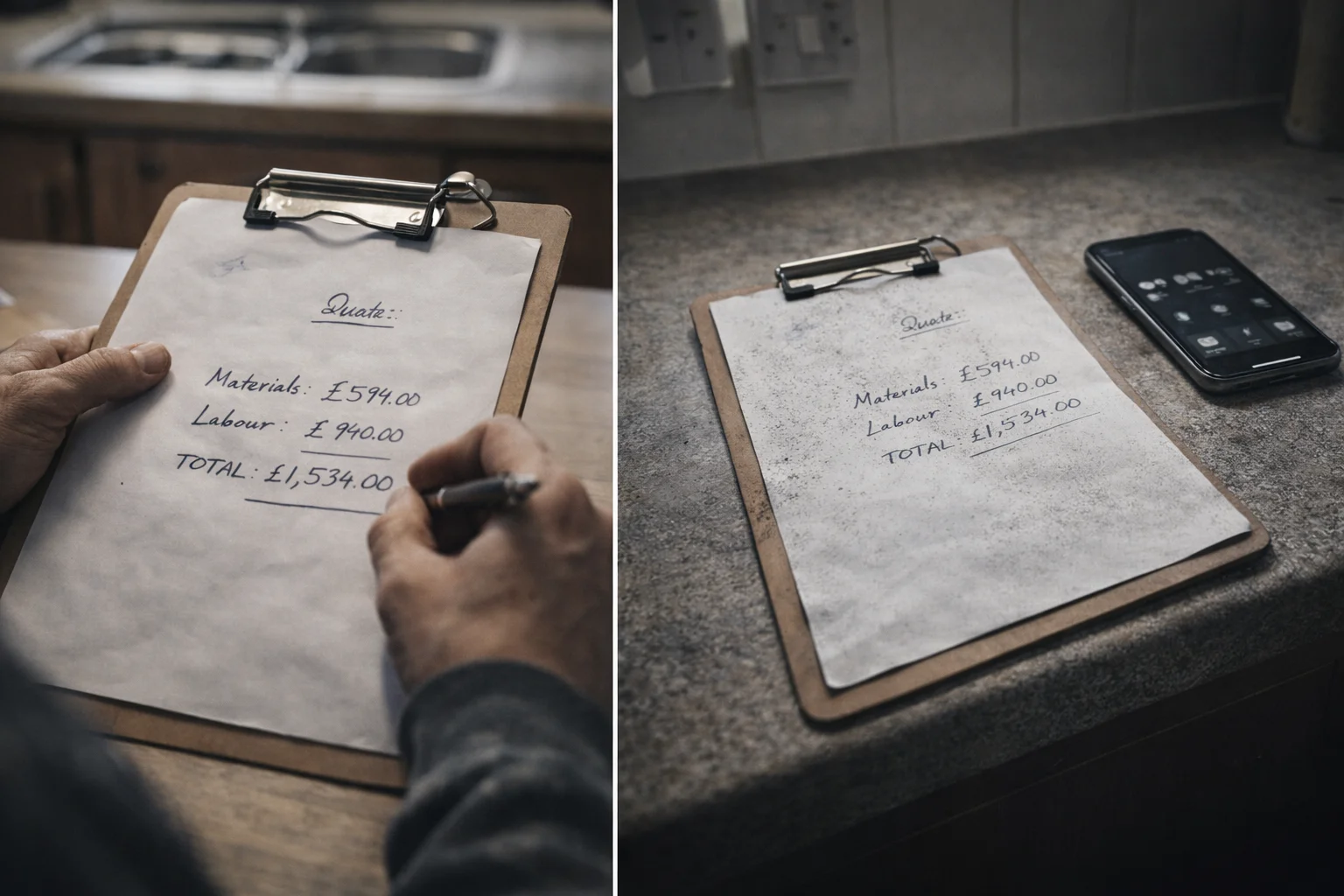
The average buying journey for a non-emergency trade job is 2 to 6 weeks from first enquiry to booking. In that window, the customer is comparing two or three quotes, processing the decision, and waiting for the right moment. If you send one quote and then disappear, you're banking on them remembering you fondly in three weeks' time when they finally decide to go ahead. That's not a strategy. That's hope.
The number: Most tradespeople convert around 30-35% of quotes into jobs. The ones with a structured follow-up system — even a basic one — convert 50-60%. On 200 quotes a year at an average of £1,200, the difference between 35% and 55% is 48 extra jobs. That's £57,600.
And the follow-up doesn't need to be complicated. Day 3: "Hi, just checking in on the quote — any questions?" Day 7: "Still interested? Happy to adjust the scope if the budget's a concern." Day 14: "Last check-in — no pressure either way, just didn't want the quote to expire without asking."
That's it. Three messages. But almost nobody sends them. The electrician in Dudley sends the quote and moves on. The builder in Walsall means to follow up but forgets. The plumber in Rugby tells himself he doesn't want to seem pushy. Meanwhile, the customer goes with the one tradesperson who did follow up — not because they were cheaper or better, but because they were the one who stayed present.
Leak #4: Zero review generation — the compound loss nobody calculates
How many Google reviews do you have? Ten? Twenty? None?
Here's why it matters more than you think, especially in the West Midlands where most tradespeople have almost no reviews.
When a homeowner in Solihull searches "plumber near me," Google shows them a map pack — usually three businesses. The ranking of those businesses is determined by proximity, relevance, and prominence. Prominence is heavily influenced by review count and average rating. If you've got 8 reviews and your competitor has 47, they're showing up above you. The homeowner clicks on the one with more reviews. That's the search they do and the decision they make. Your review count directly determines whether you appear in front of customers at all.
The compound effect: Every review you don't collect is a future lead you don't get. It's not a one-off loss — it's a permanent reduction in your visibility, which compounds over months and years. The tradesman in Leamington Spa who systematically collects reviews after every job will, within a year, be outranking competitors who've been in business twice as long.
Most tradespeople get almost no Google reviews — not because customers are unhappy, but because nobody asks. The job gets done. Everyone's satisfied. But asking for a review feels awkward, or you forget, or you're already on to the next job. So the five-star experience happens and the five-star review doesn't.
What this costs: If better review visibility sends you even 2 extra leads per month — conservative for a trade business in a town like Cannock or Stafford where competition for reviews is low — that's 24 additional leads a year. At a 50% close rate and £800 average job value: £9,600 per year. And it compounds. More reviews this year means more visibility next year means more leads the year after.
Leak #5: A website that exists but doesn't work
Having a website and having a website that generates work are two completely different things.
Most trade websites across the West Midlands fall into one of three categories:
Category 1: The "my mate built it" website. Built six years ago. Single page. No mobile optimisation. Phone number buried at the bottom. No forms. No reviews. Loads in 8 seconds. Ranks for nothing. It exists, technically. It does nothing, practically.
Category 2: The "agency hostage" website. Looks reasonable. But you don't own it — the agency does. You pay £50-200/month for "hosting and maintenance" which is code for "we own your domain and if you stop paying us, your website disappears." You can't update it yourself. Any change costs extra. And it still doesn't have a working contact form on mobile.
Category 3: No website at all. Just a Facebook page or a Google Business listing and hope for the best.
None of these are generating leads. They're digital business cards at best. A working trade website — one that actually brings in enquiries — has a specific set of characteristics:
It loads in under 3 seconds. The phone number is at the top, click-to-call on mobile. There's a form that works on every device. Reviews are visible. Services and areas are listed (this is how Google knows to show you for "electrician Nuneaton" rather than just "electrician"). It has proper title tags, meta descriptions, and structured data. It's designed to do one thing: turn a visitor into an enquiry.
What a broken website costs: If your website currently converts at 1% (typical for a poorly built trade site) and a decent one converts at 4%, and you're getting 500 visitors a month (realistic for a tradesperson with a Google Business listing), the difference is 15 extra enquiries per month. At 50% close rate and £800 per job: £6,000 per month. £72,000 per year.
Even if your numbers are half of that — 250 visitors, 3% conversion rate — you're still looking at five figures in missed revenue. From a website you're already paying for.
Leak #6: Invisible on Google — the SEO gap
Here's something most tradespeople don't know: the West Midlands outside Birmingham is one of the easiest places in the UK to rank on Google for trade services. And almost nobody is doing it.
Why? Because most SEO companies target Birmingham — it's the biggest search volume, the most businesses, the highest competition. Which means the smaller towns get ignored. Wolverhampton, Tamworth, Stafford, Nuneaton, Redditch, Bromsgrove — these areas have real search demand and almost zero competition for the top organic spots.
"Plumber Wolverhampton." "Electrician Tamworth." "Roofer Stafford." "Builder Nuneaton." Search any of these and you'll find the results are weak. Outdated directories, Checkatrade listings, and a handful of businesses with basic websites. A tradesperson who puts even moderate effort into local SEO in these towns could rank on the first page within weeks.
What this means in revenue: Ranking in the local map pack for your primary trade + town generates an average of 20-40 organic leads per month for a typical trade keyword. Even at the low end — 15 leads per month, 50% conversion, £600 average job — that's £54,000 per year in organic leads. Leads that cost you nothing per click, nothing per lead, and keep coming month after month.
The tradesperson in Coventry who's paying £500/month for Google Ads but has no SEO is renting traffic instead of owning it. The one in Lichfield who's spending nothing on marketing but also has no online presence is leaving the entire search channel on the table.
Leak #7: No forms, no capture — leads with nowhere to land
Your phone is off while you're working. Fine. But is there anywhere else for a potential customer to reach you?
Most trade businesses have exactly one contact method: the phone number. If the call goes unanswered, the lead is dead. No form. No text-back. No chat. No booking calendar. Just a voicemail box that nobody uses and a callback that comes too late.
A lead capture system doesn't replace the phone call. It catches the ones the phone misses. When someone can't reach you, a form on your website or an automated text message gives them another way in — one that doesn't require you to be available at that exact moment. They type their name, their postcode, the job description, and hit send. The lead is captured. You respond when you're free.
For a tradesman in Rugby or Cannock, this is the difference between "3 calls came in while I was on site, I missed all 3, and they're gone" and "3 calls came in, I missed all 3, but all 3 are sitting in my inbox with their details and I'll call them on my lunch break." One of those scenarios costs you nothing. The other costs you potentially £2,400 in a single morning.
Leak #8: Manual everything — the invisible time tax
This one doesn't show up as a revenue leak. It shows up as time. And time, for a tradesperson, is revenue.
Consider the weekly admin load for a typical sole trader in the West Midlands:
Quoting: Write the quote. Type it into an email or WhatsApp message. Send it. Copy it into a notebook or spreadsheet. Hope you remember to follow up.
Scheduling: Check your diary. Check the customer's availability. Send a text to confirm. Another text the day before. Call them the morning of if they haven't confirmed.
Invoicing: Write the invoice. Send it. Wait. Chase. Wait. Chase again.
Follow-up: Remember that the customer in Sutton Coldfield wanted a callback next week. Try to remember. Forget. Lose the job.
Each of these processes takes 10-20 minutes per job. Across 15-20 jobs per month, that's 5-7 hours of pure admin. Hours you could be on the tools, earning. At a typical trades day rate of £250-400, the time cost of manual processes is £1,250-2,800 per month. That's up to £33,600 per year — not in lost revenue, but in lost earning capacity.
The alternative isn't hiring a PA. It's having systems that handle the repetitive parts automatically. Quotes that auto-send a follow-up on day 3. Booking confirmations that fire without you typing them. Invoice reminders that chase payment on a schedule. Review requests that send themselves after every completed job.
The tradesman in Dudley who automates his follow-up sequence doesn't work fewer hours. He works the same hours and earns more, because the hours he was spending on admin are now spent on billable work.
The compound cost — what it all adds up to
Here's where it gets uncomfortable. Let's stack these leaks together for a typical sole trader or small team in the West Midlands.
| Revenue Leak | Conservative Annual Cost |
|---|---|
| Missed calls (3/week × £800 × 65%) | £78,000 |
| Slow response time (losing to faster competitors) | £15,000 |
| Quotes dying from no follow-up | £57,600 |
| No review generation (lost visibility) | £9,600 |
| Broken/absent website (missed conversions) | £36,000 |
| No SEO (missing organic leads) | £27,000 |
| No lead capture forms | £12,000 |
| Manual processes (time cost) | £20,000 |
| Total potential revenue leak | £255,200 |
Now — nobody is losing all of these simultaneously at the maximum rate. There's overlap. Some of these feed into each other. A missed call is also a slow response. A broken website is also a missed lead capture.
But even if you take a third of that total — the absolute floor for a trading business with no systems — you're looking at £50,000+ per year in revenue that's either walking out the door or never arriving in the first place.
Fifty grand. Every year. Invisible.
And the tradesman in Tamworth who's earning £60,000 and thinks he's doing alright? He's actually running a £110,000 business. He just can't see the other half.
Why the West Midlands specifically
This isn't a London problem or a Manchester problem. The dynamics described here exist everywhere. But the West Midlands has a specific set of conditions that make these leaks larger and easier to fix than in most other regions.
High demand, low digital competition. The housing stock across Wolverhampton, Dudley, Walsall, and the Black Country towns is older, denser, and requires more ongoing maintenance work. Demand for trades is consistently strong. But digital adoption among tradespeople here is behind London, the South East, and the Northern cities. Fewer businesses have proper websites. Fewer have any form of automation. The gap between what customers expect (instant response, online booking, professional follow-up) and what most tradespeople deliver (voicemail, maybe a callback tomorrow) is wider here than almost anywhere else in England.
Lower competition for search visibility. In Birmingham, ranking for "plumber near me" is genuinely competitive. In Wolverhampton, Coventry, Stafford, Nuneaton, Tamworth, and Leamington Spa, it's comparatively open. The tradespeople who move first on local SEO in these towns will own those positions for years before anyone else catches up.
Strong community-driven word of mouth — but it has a ceiling. West Midlands towns have tight communities. Word of mouth works well. But it plateaus. It can't scale. And it can't sustain a business through quiet periods because you have zero control over when someone mentions your name to their neighbour. The businesses that supplement word of mouth with a digital presence and an automated lead system are the ones that break through the £80k-100k ceiling that most sole traders hit and can't seem to get past.
The pattern behind all eight leaks
Read back through the eight leaks and you'll notice something.
Not one of them is a skills problem. Not one of them is a quality problem. Not one of them is about your prices, your work ethic, or how good you are at the job. Every single one is a systems problem.
Missed calls? System problem. Slow response? System problem. Dead quotes? System problem. No reviews, no SEO, no lead capture, no website, manual admin? Systems. All systems.
The tradespeople in the West Midlands who earn consistently — the ones who don't have a quiet January, who aren't checking their bank balance nervously in the third week of December — are not the most skilled. They're the ones who built the infrastructure around the skill. The phone gets answered (or automatically responded to). The quotes get followed up (automatically). The reviews get collected (automatically). The website ranks. The leads convert. And the tradesperson does what they're actually good at: the work.
Systems compound. Skills plateau. A decent plumber with a great system will outperform a brilliant plumber with no system, every single time. Because the brilliant plumber is losing half his leads before he ever gets to demonstrate how brilliant he is.
What you can do about it — in priority order
You don't need to fix all eight at once. You need to fix the biggest one first and let the momentum carry you.
Priority 1: Stop the missed call bleed. This is the single highest-value fix for any trade business. An automated text-back system that fires within 60 seconds of a missed call typically recovers 60-80% of leads that would have been lost. One fix. Immediate revenue impact.
Priority 2: Build a basic follow-up sequence for quotes. Day 3, Day 7, Day 14. Three messages. Not aggressive. Not salesy. Just present. This alone can push your quote conversion rate up by 15-20 percentage points.
Priority 3: Set up automated review requests. After every completed job, a text goes out asking for a Google review. This compounds over months. Within six months you'll have noticeably more reviews than your competitors, and Google will start showing you higher in local results.
Priority 4: Get your website working. Not just existing — working. Phone number at the top. Working mobile form. Services and areas listed. Loading in under 3 seconds. If your current website isn't doing all of that, it's a liability, not an asset.
Priority 5: Invest in local SEO. For tradespeople in Wolverhampton, Coventry, Tamworth, Stafford, Nuneaton, Lichfield, Redditch, Cannock, and the rest of the West Midlands — the local SEO opportunity is wide open. A properly optimised Google Business Profile and a website targeting "[your trade] + [your town]" will generate organic leads within weeks, not months.
You don't need everything at once. You need the first thing working, generating revenue, and paying for the next one. Stack them over six months and the business looks completely different.
The honest version
The tradespeople in the West Midlands who break through the £100k ceiling aren't the most talented. They're the ones who stopped relying on their phone ringing and started building systems that capture, convert, and follow up on every lead — whether they're free to answer or halfway up a roof in Solihull.
Every pound you're earning right now, you're earning despite these leaks. Imagine what the number looks like when they're plugged.
If you want to know exactly where your business is leaking revenue, a system audit will show you in 15 minutes. It's free. It's not a sales pitch. It's a diagnostic — your actual numbers, your actual leaks, and a straight answer on what to fix first. Book one here.
This article was written for UK tradespeople in the West Midlands — plumbers, electricians, roofers, builders, heating engineers, and every other trade — who are doing great work and wondering why the numbers don't reflect it. The answer is almost never the work. It's everything around it.
Where to take this next
For UK trade businesses — sole traders, small crews, multi-trade firms — see APLeads Done For You. £4,000 one-time. Built in days. Everything delivered inside your accounts. No ongoing APLeads subscription.
For premium service operators with £500,000+ project values (luxury design and build, HMO developers, high-end interior designers, bespoke joinery, specialist construction), see APLeads Premium Services — bespoke pricing, six firms per quarter, intent-based system designed for long sales cycles.
Or if you want a free 30-minute audit call to look at your numbers and recommend the right tier, book one here.
Related articles
How Premium Service Companies Win More High-Value Contracts Online
Most premium contractors lose six figures a year to competitors with better digital systems. Here's …
How to Attract High-Net-Worth Clients for Luxury Home Renovations
Most UK luxury design and build firms lose £500,000+ projects every quarter to competitors who simpl…
Best Lead Generation Agencies for Luxury Construction Firms (2026 Comparison)
Most luxury construction firms hire the wrong type of agency, lose ten months of fees, and end up wo…