You know the cost of your van to the penny. You have no idea what your phone is costing you.
Van finance: £600/month. You know it. Insurance: £1,200/year. You know it. Tools, fuel, materials — all tracked. All accounted for.
But the calls you miss while you're on site? That figure doesn't show up anywhere. Not in your bank account. Not in your accounts. Not on any invoice.
It just disappears.
And in most trades businesses in the UK, that invisible number is bigger than every other cost combined.
The maths nobody's doing
Let's put a real number on it.
The average trade business misses 40% of inbound calls during working hours. That's not a guess — it's the number that comes up consistently across plumbers, electricians, roofers, and builders in the UK. You're on site. Your hands are full. The phone rings. Voicemail.
What happens next? In most cases, nothing. The customer moves on. They don't leave a voicemail. They call the next number on Google. That job — your job — goes to someone else.
Now for the numbers:
- Average trade job value: £800 (being conservative)
- Calls missed per week while on site: 3
- Working weeks per year: 50
- Jobs you'd close from those calls: 65%
That's 97 jobs a year you'll never see. At £800 each: £77,760.
Round it up. Call it £78,000.
That's not a bad month. That's a bad year. Every year. On repeat.

And the brutal part is: you'll never see those leads arrive, so you'll never feel them leave. Your diary doesn't show the jobs that didn't book. Your bank doesn't show what would have come in. The missed call just vanishes, and you assume it was a quiet week.
It wasn't a quiet week. Your phone was off while you were working.
Why callbacks don't fix it
Most tradespeople know they miss calls. The usual solution: call everyone back at the end of the day.
Here's why that doesn't work.
Speed wins in trades. When a customer has a leaking pipe or a broken boiler, they're not loyal to whoever quotes best. They're loyal to whoever responds first. If you call back 4 hours later, there's a strong chance they've already booked someone else and moved on.
In fact, studies across the trade sector consistently show the same pattern: call back within 5 minutes and conversion rates are around 50%+. Call back after an hour and they drop below 20%. Call back at 6pm? You're lucky if one in ten even answers.
It's not because customers are impatient or unreasonable. It's because urgent problems need urgent solutions, and whoever gets there first gets the job.
Four-hour callbacks aren't customer service. They're a courtesy call to confirm you lost the lead.
The problem isn't you — it's the structure
Here's the thing most people miss: this isn't a work ethic problem. It's a structural problem.
You're doing exactly what you should be doing. You're on the tools. You're delivering the work. You can't answer a phone while you're up a ladder or wiring a board. That's not laziness. That's just physics.
The structure of a solo or small trade business is fundamentally broken for handling inbound enquiries in real time. You've got one person doing the job and taking the calls. That doesn't work when both things happen at the same time — which is always, when you're busy.
The businesses that solve this don't hire a receptionist (most don't have the margin for that). They build a system that handles the gap.
When a call comes in and you can't answer: the system picks it up, sends the customer a text within 60 seconds, asks a qualifying question, and either books them in or flags them for you to call back with full details ready. Customer feels looked after. Lead is captured. You find out when you're back in the van.
That's the fix. Not working harder. Not calling back faster. Just not letting the lead disappear in the first place.
What "fixing it" actually looks like day to day
Here's a real example. Not a case study — just the typical flow once a system's in place.
Monday, 10:47am: You're replacing a bathroom suite in Solihull. Phone rings. You don't answer.
10:47am: Caller gets a text: "Hi, it's [Your Name] Plumbing. Sorry we missed you — we're with a customer right now. Can I ask what the job is and what area you're in? We'll get back to you within the hour."
10:49am: They reply. It's a boiler service in your postcode. Exactly the kind of job you want.
10:49am: They're logged in your system with their name, number, location, and job type.
12:15pm: You finish up. You have 4 messages in your van list. You call the boiler service first. They pick up. They'd nearly booked someone else but hadn't quite got round to it. You get the job.
Total time to close: 2 minutes on the phone. Job value: £250–400.
That's it. No extra marketing. No new leads. Just the ones that were already coming in, not getting lost.
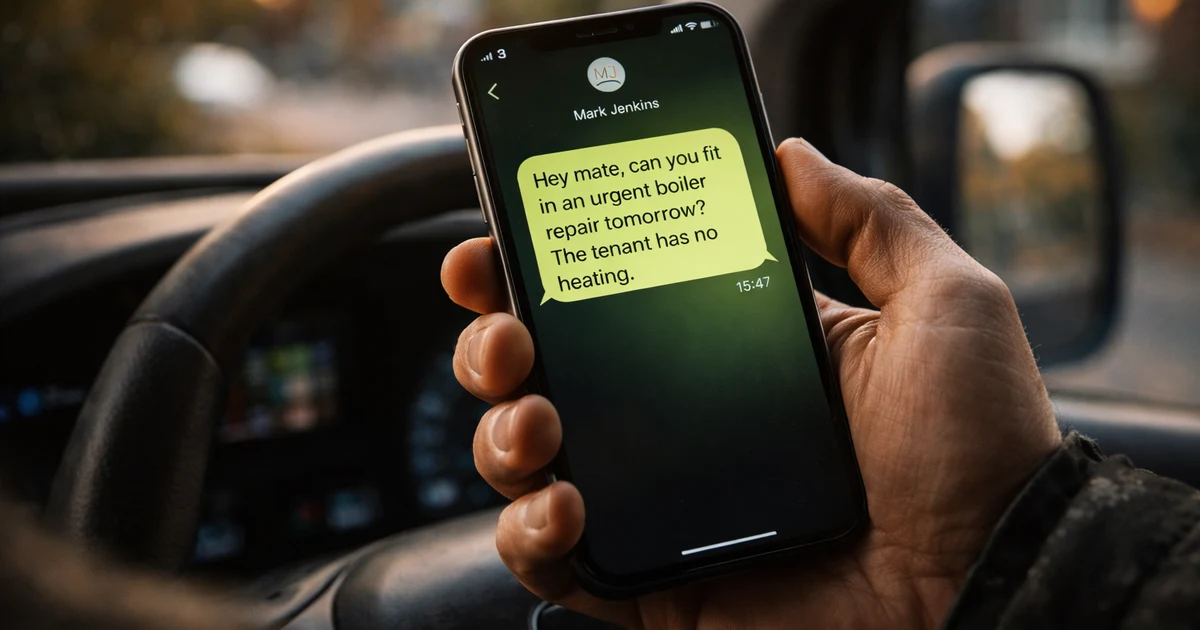
What it costs vs what it saves
The system that does this isn't free. But it's a rounding error next to what the phone is quietly bleeding out of your business every week.
Revenue recovered from missed calls: At the conservative end — if you're currently missing 3 leads per week and you recover just 1 of them per week, at £800 average: £3,200/month in recovered revenue.
One investment. Yours outright. No rolling retainer. No agency hostage situation. The system pays for itself out of the first two recovered jobs. Everything after that is profit you weren't seeing before.
We don't publish a price — every trade business is different. Your call volume, job values, and current setup all move the maths. Book a free System Audit and we'll show you exactly what it looks like for your business on the call.
Even if you're a smaller operation and only recover half a lead per week — a very cautious estimate — you're still looking at a 5:1 return on every pound you put in.
The system pays for itself in the first two weeks. Every month after that is profit that wasn't there before.
The objections we hear most
"I get enough work already."
Good. But when the quieter period hits — and it always does, winter comes for everyone in trades — you'll want those leads captured and sitting in a pipeline, not gone forever because you were busy in September.
"My customers prefer to speak to a real person."
They do. And they will — the callback rate when leads are captured properly is significantly higher than cold calling, because the customer already engaged once. You're not cold-calling. You're returning to someone who already wanted to reach you.
"I've tried stuff like this before and it didn't work."
Most of the systems that don't work are generic, not trade-specific. A proper setup is built around how a trades business actually operates: job types, postcode filtering, booking windows, seasonal changes. Generic automation tools don't do that. Built-for-trades systems do.
"I don't have time to set it up."
You don't have to. That's the point. A done-for-you install means someone else sets it up, tests it, and hands it over. You need about 30 minutes to brief them on your business. That's it.
The decision
You've got a van. You've got tools. You've got skills.
The only part of your business losing money silently, every single day, is the phone.
It's fixable. It's not expensive to fix. And it's the difference between a business that runs on whoever calls you versus one that captures everyone who tries.
Book a free System Audit at apleads.co. We'll scan your current setup, show you exactly how many leads you're likely losing, and give you a straight answer on whether a system makes financial sense for your business.
No sales pitch. No pressure. Just a number — what it's currently costing you, and what it would cost to stop.
Most trades are genuinely surprised by the first number.
APLeads builds AI lead capture systems for UK tradespeople. We work with plumbers, electricians, roofers, and builders who are done losing work to missed calls.
Where to take this next
For UK trade businesses — sole traders, small crews, multi-trade firms — see APLeads Done For You. £4,000 one-time. Built in days. Everything delivered inside your accounts. No ongoing APLeads subscription.
For premium service operators with £500,000+ project values (luxury design and build, HMO developers, high-end interior designers, bespoke joinery, specialist construction), see APLeads Premium Services — bespoke pricing, six firms per quarter, intent-based system designed for long sales cycles.
Or if you want a free 30-minute audit call to look at your numbers and recommend the right tier, book one here.
Related articles
How Premium Service Companies Win More High-Value Contracts Online
Most premium contractors lose six figures a year to competitors with better digital systems. Here's …
How to Attract High-Net-Worth Clients for Luxury Home Renovations
Most UK luxury design and build firms lose £500,000+ projects every quarter to competitors who simpl…
Best Lead Generation Agencies for Luxury Construction Firms (2026 Comparison)
Most luxury construction firms hire the wrong type of agency, lose ten months of fees, and end up wo…